Between Action and Letting Go
A Personal Framework of Eight Mantras
You can read this piece through two lenses:
The content: eight mantras that guide how I live
The way of thinking: turning scattered wisdom into a personal framework
The Wisdom Gap
There is a gap I keep noticing within myself between knowing something intellectually and acting accordingly. But this gap isn’t universal. It depends on the nature of the knowledge: whether it’s information or wisdom. Information is easy to acquire. Wisdom is something else entirely and understanding how ideas make that leap from intellectual to lived is what interests me here. This piece is about the latter.
You can see this gap play out in what ideas actually stay with us. Some thoughts disappear almost immediately. They sounded good when we read them, but they never truly resonated. Others linger in the mind — you recognize their insight, maybe even admire their clarity — yet they remain abstract, disconnected from daily life. And then there are a few ideas that survive repeated contact with reality. They get tested, challenged, and returned to. Over time, they stop feeling like ideas at all and start functioning as lived principles.
The reason for this is simple: understanding alone doesn’t change how we act. An idea — especially the kind of advice we encounter in books or teachings — only becomes useful once it starts shaping behavior without requiring constant (and conscious) effort. Because wisdom isn’t something we accumulate intellectually. It’s something we absorb slowly, until it begins to operate beneath conscious thought.
Why Structure Matters
I’ve found that what helps bridge this gap is structure. When an idea matters enough to guide how I live, I don’t want it floating in isolation. I want to be able to locate it, relate it, and return to it when clarity is hardest to access.
That’s why I hold the ideas I want to live by as mantras: short, precise phrases I can reach for under pressure. And rather than keeping them as a scattered list, I organize them in a framework: one that makes their relationships visible and connects them to broader principles.
That’s the role this framework plays for me: to make the right thing easier to remember when it matters most.
Defining “Mantra”
Before showing you the framework itself, it helps to be precise about what I mean by mantra.
A mantra, as I’m using the word here, is a simple, memorable phrase that holds a core truth. It’s something that has survived repetition, experience, and pressure. It might sound profound or simple, but it continues to work whenever I use it.
A few constraints matter to me:
If it takes three paragraphs to explain, it’s useless under pressure.
Its purpose isn’t to teach something new in the moment. It’s a mental cue to remember.
It’s what I return to when I’ve lost my way, such as in a crisis, in very low or very high emotional states, or when a decision feels too complex.
It reminds me of a commitment I made when I was calm.
In popular use, the word ‘mantra’ often carries spiritual or transformative associations. People repeat mantras expecting the repetition itself to transform them. That’s not what I mean here. Repetition helps solidify memory, but a mantra, as I’m defining it, is much simpler and more practical: it’s a behavioral, mental, or moral anchor you’ve already internalized; and something you return to when you need it most.
The Framework
I’ve organized the eight mantras that survived this process into a map.
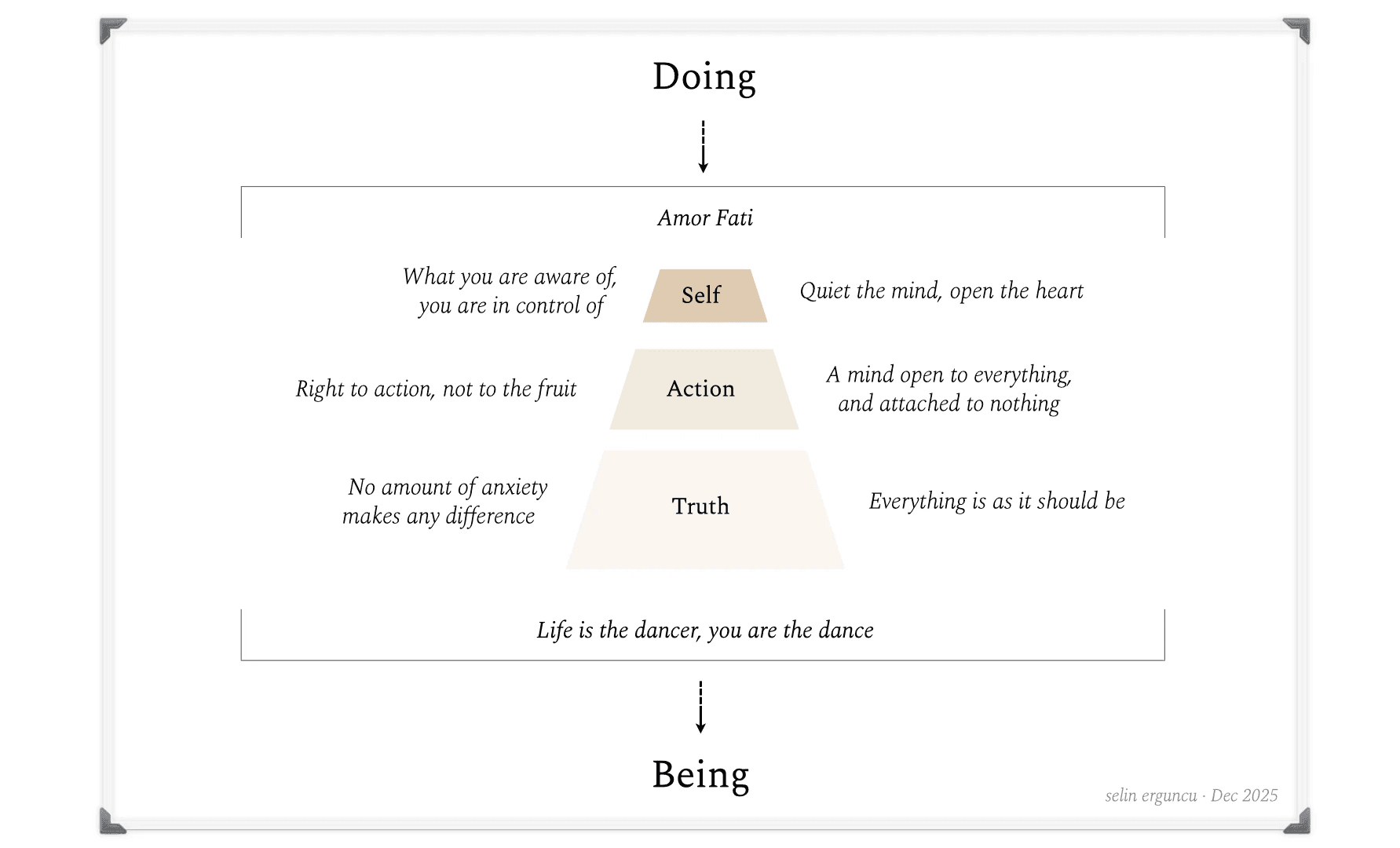
The visualization matters because this framework isn’t just a list. It describes a journey: a movement from maximum effort to maximum release. In other words, from fierce agency to total surrender.
At the top, effort is intentional and active. You’re choosing. You’re exerting will. As you move downward, the emphasis gradually softens: from disciplined action into acceptance, and finally into release. From the hard yes of embrace to the soft yes of surrender.
What this framework offers is a way to locate yourself: to recognize where you are in the movement between effort and release, and what might be needed next.

The Poles
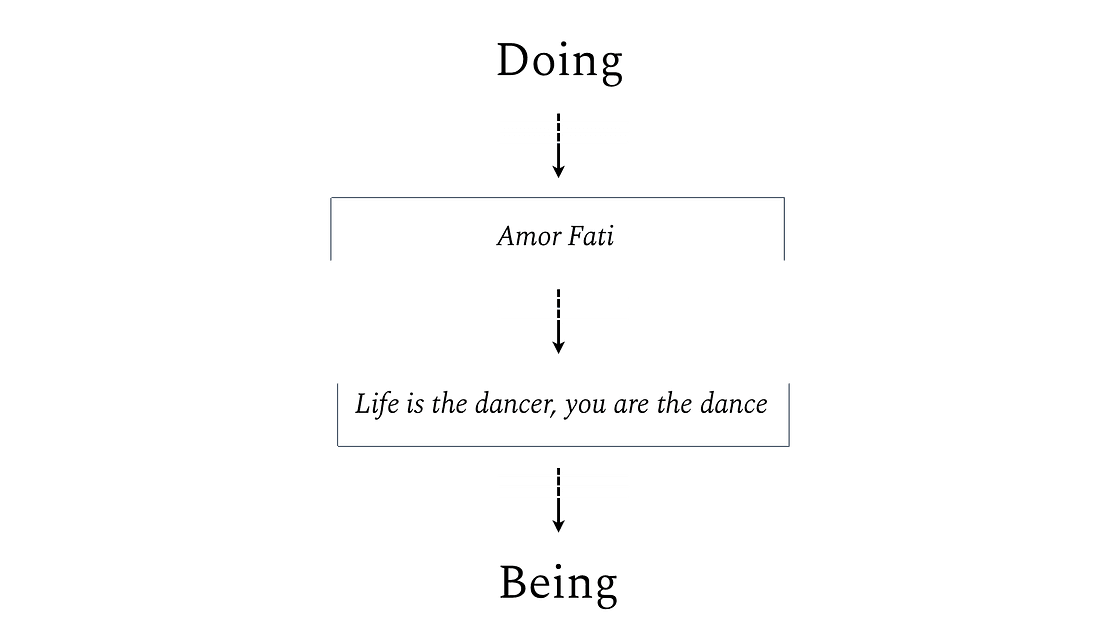
The structure is held by two poles: a strong yes and a soft yes.
At the top is Amor Fati: the active embrace. This is the most effortful stance. You choose to love your fate. It requires intention, fierceness, and will. You say yes with your whole self to whatever comes.
At the bottom is Life is the Dancer, You are the Dance: the soft surrender. Here, you’re no longer the one doing, you’re being moved by life itself. You’ve moved from active embrace into complete release. You stop directing the movement and allow yourself to be carried by it.
This is what the Taoists called wei wu wei (action through non-action), or what Zen teachers describe as being lived by life itself.
These two are the boundaries the rest of the system lives inside.
The Three Layers Between
Between these two poles, the mantras organize themselves into three layers.
Layer 1: Self
Before you can act effectively, your internal system has to be clear. This layer is about awareness: noticing unconscious patterns, mental noise, and emotional contraction. A closed system can’t move cleanly.
Layer 2: Action
Once there’s internal alignment, attention shifts outward. This layer is about disciplined action: doing what’s in front of you today, without collapsing into anxiety or attachment to outcomes.
Layer 3: Trust
As action meets the world, you encounter what you cannot control. This layer is about trust: releasing resistance, accepting what is, and softening your grip on outcomes. Trust is the bridge between effort and surrender.

The Movement
There’s a natural flow through the framework: a movement from doing into being, from effort into surrender.
Awareness enables wise action. Wise action meets trust. Trust invites surrender.
You start closer to Amor Fati: active, choosing, exerting will. As you move through these layers, effort gradually gives way to trust, and you soften toward the Dance.
But this isn’t about passivity. The deepest wisdom is knowing when to hold and when to release.
A Note on Language
Many of these mantras parallel concepts from Dialectical Behavior Therapy (DBT), Cognitive Behavioral Therapy (CBT), and Acceptance and Commitment Therapy (ACT).
This isn’t coincidence. In my study of these frameworks, I’ve noticed they emerged from observing what actually helps people navigate suffering. That’s the same foundation ancient philosophy and contemplative practice were built on. They converge because they’re responding to the same underlying human patterns, just using different vocabularies.
Where relevant, I’ll note these connections as I see them. The parallels exist because both traditions are mapping the same territory. If you’ve encountered these concepts in therapy, you might find new angles here. If you haven’t, the mantras stand on their own.
The Eight Mantras
1. Amor Fati
“Love your fate.”
— Stoic philosophy, later popularized by Friedrich Nietzsche (19th century)
This is the strong yes. The active embrace.
Amor Fati doesn’t mean tolerating what happens to you. Nor does it mean gritting your teeth and getting through it. It means loving what happens. Choosing it. Saying yes with your whole self. Not despite the difficulty, but including it.
That’s what makes this the fiercest of all the mantras. It requires will. It asks you to look directly at whatever is unfolding and say: this is mine to live, and I will love it because it’s mine.
I won’t pretend I’m good at this. Most of the time, I live somewhere between reluctant acceptance and quiet frustration. But Amor Fati sits at the top of my framework as a reminder of what’s possible, like a north star more than a daily achievement.
And when I manage to touch it, even briefly, something shifts. The struggle stops being something to escape and becomes something to meet. And in that meeting, there’s a strange kind of freedom.
Psychology connection
If you’re familiar with Dialectical Behavior Therapy, you might recognize an echo here of what DBT calls radical acceptance. In DBT, radical acceptance is the active choice to stop fighting reality. Amor Fati moves in the same direction, but with a different tone. Where radical acceptance says “this is what’s happening, and I will not resist it,” Amor Fati asks something more demanding: “this is what’s happening, and I will love it.” The move is similar. The stance is stronger.
2. What You Are Aware Of, You Are In Control Of
“What you are aware of you are in control of; what you are not aware of is in control of you.”
— Anthony de Mello, Jesuit priest and spiritual teacher (1931–1987)
This is where everything begins.
Wise action requires knowing what’s driving you. Real choice requires seeing the patterns that would otherwise move you unconsciously. The parts of yourself you don’t notice, the unconscious habits, the conditioning, the old wounds, make your decisions before you know there’s a decision to make.
De Mello’s line reframes self-awareness as freedom. The practice isn’t endless self-analysis or obsessing over yourself. It’s seeing clearly enough to create space, and in that space, choice becomes possible.
This is the foundation of the whole framework. Without awareness, every other mantra is just words. You might intellectually agree with “let go” or “accept what is,” but if you can’t see what you’re gripping or resisting in the first place, you’re just performing wisdom. Not living it.
Knowing yourself is the beginning. Just noticing. And somehow, in the noticing, things begin to shift on their own.
Psychology connection
If you’re familiar with therapeutic frameworks, you might recognize this mantra across several traditions. In DBT, it sits at the foundation: mindfulness as the practice of observing and describing experience without judgment. In CBT, it appears as thought monitoring: learning to notice mental patterns before they harden into automatic emotional reactions. And in ACT, it shows up as cognitive defusion: the shift from “I am anxious” to “I’m noticing anxiety.”
The language differs, but the principle is the same. Awareness creates space. And that space makes choice possible. When a thought or pattern becomes visible, it loosens its grip. You’re no longer inside it. You’re the one noticing it.
And that subtle shift changes everything.
3. Quiet the Mind, Open the Heart
“Quiet the mind, open the heart.”
— Ram Dass, American spiritual teacher and author (1931–2019)
This one is closest to my heart, both because it’s from Ram Dass and because I’ve been reminded of it at moments when I needed it most.
Last year, I visited Ram Dass’s sanctuary in Maui. I chanted in his temple, walked through his garden overlooking the ocean, and stood in the bedroom where he passed away. I broke down crying in that backyard. The teaching he lived his whole life pointing toward felt present there: the quieting, the opening, the trust in something larger than thought.
To me, this mantra is about moving from thinking to a different kind of knowing.
There’s intuition, which is quick. A gut feeling that tells you not to take that meeting, not to go on the second date, not to trust that offer. It’s subtle, but once you learn to listen, it speaks often.
And then there’s something deeper. What I think of as inner knowing. It doesn’t arrive quickly. It shows up when you sit with a real question, one that actually matters, and stop trying to think your way to an answer. Then you wait. Sometimes nothing comes. And sometimes, without effort, something does. Not a thought. A knowing.
That kind of knowing only surfaces when the mind is quiet and the heart is open.
I’ve also come to see this mantra as an instruction in non-judgment. A noisy mind rushes to label, evaluate, and react. A quiet mind has more room to notice. And an open heart doesn’t need to decide who or what deserves understanding.
Ram Dass learned this from his teacher, Neem Karoli Baba (Maharaji), whose instruction was radically simple: “tell the truth, love everyone.” But you can’t tell the truth if you’re lost in mental noise, and you can’t love with a closed heart. And you can’t love someone you’re busy judging.
So this mantra is both a practice and a reminder for me: to soften the mind, stay open, and listen for what becomes clear when I stop forcing answers.
Psychology connection
In DBT, this is Wise Mind: the integration of reasonable mind (logic, analysis) and emotional mind (feeling, intuition). The goal isn’t to suppress emotion or override logic — it’s to access the space where both meet. That’s where inner knowing lives. Wise Mind doesn’t argue or justify. It simply knows. ACT would call this psychological flexibility: the ability to be present with what arises without being controlled by thoughts or overwhelmed by feelings. Both frameworks point at the same capacity: a centered knowing that’s larger than either thinking or feeling alone.
4. Right to Action, Not to the Fruit
“You have the right to work, but never to the fruit of work.”
— Bhagavad Gita, ancient Hindu scripture (circa 200 BCE-200 CE)
This one comes from the Bhagavad Gita, and I return to it constantly.
It draws a sharp line between what is mine to do and what isn’t. I can show up today. I can take the next right step. I can act with care, discipline, and intention. But the outcome — the result, the reward, the “fruit” — is never fully under my control.
Let’s give an example. You want to lose weight, so you eat well today. You’re not going to see results today. But that’s not the point. Eating well today is the only thing you can actually do. The outcome, the “fruit,” isn’t yours to control.
This sounds simple, but it’s quietly revolutionary. It means you can put your whole self into something without being attached to how it turns out. You do your part fully, and then you release.
This is where action meets letting go. You act completely while holding the outcome loosely. The doing is yours. But the result belongs to something larger than you.
The instruction is simple to understand: give your full attention to what’s in front of you, without negotiating with the future. But internalizing it — making it automatic rather than intellectual — is another thing entirely. When it does land, even partially, the relief is immediate.
The instruction is so simple to understand: give your full attention to what’s in front of you, without negotiating with the future. As I mentioned in the intro, it is so easy to understand intellectually, but really internalize it so hard and also whenever even partially successful, so rewarding and freeing.
When I forget this, I notice how quickly effort turns into expectation, expectation into anxiety. If the outcome is bad, anxiety becomes disappointment, resentment, anger, guilt. If the outcome is good, it becomes attachment, a false sense of control that makes the next disappointment possibly even harder.
Psychology connection
In ACT framework, this is values-based action: doing what aligns with your values regardless of whether it produces the outcome you want. The commitment matters, not the reward. CBT calls a version of this behavioral activation: taking action based on what’s important rather than waiting until you feel like it or until success is guaranteed. Both frameworks separate the fruit (outcome) from the action (what you can control). You act because it’s aligned with who you want to be, not because you’re promised a specific result. Meaning comes from committing to action that reflects your values, again and again, without using success as the price of engagement, not from controlling results.
5. Have a Mind Open to Everything and Attached to Nothing
“Have a mind that is open to everything and attached to nothing.”
— Tilopa, Indian Buddhist master (10th century)
This one contains two instructions in a single line.
The first is openness: a willingness to meet what comes without preemptive judgment. Openness means responding to unfamiliar ideas with curiosity, considering possibilities before closing them off. It’s receptivity without requiring agreement.
I find this mantra especially grounding in a culture that treats offense as a reflex and certainty as virtue. A mind open to everything isn’t scanning for reasons to be upset.
Wayne Dyer, who introduced me to this quote, pointed out something I’ve noticed too: most people spend their lives looking for occasions to be offended. And there’s never a shortage. A mind that is open to everything simply isn’t scanning for offense.
The second instruction is non-attachment: the freedom that comes from loosening your grip. Attachment is the belief that without this thing, this outcome, this person behaving the way I want, I cannot be okay. Non-attachment is knowing that my peace doesn’t depend on circumstances lining up perfectly.
Anthony de Mello, another teacher I return to often, offered a test for relationships: I leave you free to be yourself, to think your thoughts, follow your inclinations, behave in ways that you decide are to your liking. That’s non-attachment in practice. Caring deeply while holding loosely.
This balance, openness without entanglement, is a practical kind of freedom. I can listen fully without losing myself to what I’m hearing, disagree without hardening, and care deeply without clinging.
That’s why this mantra lives in the Action layer. It describes how I aspire to move through the day: open to what arrives, unattached to what already passed or hasn’t happened yet. Like all the mantras in this framework, this isn’t just an idea to hold intellectually. It’s a practice I’m constantly trying to remember. And when I forget, life has a way of reminding me quickly.
Psychology connection
In ACT, this maps to cognitive defusion: holding thoughts and beliefs lightly rather than being fused with them. You notice what arises, such as thoughts, emotions, impulses, without being controlled by them. DBT calls this the non-judgmental stance: observing without adding layers of evaluation. Both point toward what ACT calls psychological flexibility: the ability to stay present and open to experience while acting according to your values, regardless of what thoughts or feelings show up.
6. No Amount of Anxiety Makes Any Difference
“No amount of anxiety makes any difference to anything that is going to happen.”
— Alan Watts, British-American philosopher and interpreter of Eastern philosophy (1915–1973)
This one catches me every time I start spinning.
There’s a particular kind of mental loop I fall into: running through scenarios, rehearsing conversations that haven’t happened yet, trying to anticipate every way something could go wrong. It feels productive, responsible even. It feels like thinking ahead. I love being prepared, and this seems like the way to do it: if I can just anticipate what might go wrong, I can take the necessary actions in advance. Or at least not get caught off guard.
For a long time, I didn’t call this anxiety. I knew enough about anxiety to know I didn’t want to be doing that, so I labeled it something else. Strategic thinking. Mental preparation. Being thorough. But lately, I’ve come to accept that this is anxiety. Just dressed up in more acceptable language.
This mantra cuts through the illusion that anxiety is doing something useful. Anxiety doesn’t prepare me for what’s coming, and it doesn’t change outcomes. It just burns up the present moment and replaces it with futures that mostly never arrive.
I want to emphasize a point here. There is a difference between planning and anxiety, though the line can be hard to see. Here’s the distinction I’ve ended up with: Planning moves. It gathers information, considers options, then decides on action. Anxiety circles. It replays the same scenarios without moving toward resolution. It mistakes mental repetition for actual preparation.
So when I catch myself replaying the same conversation for the fifth time, or running through a scenario that hasn’t changed since the last three times I rehearsed it (as if this time it’ll reveal something new), I try to pause and ask this simple question: is what I’m doing right now actually helping? The answer is almost always the same. It’s not changing what’s going to happen; it’s just taking me out of the only moment I actually have.
There’s a strange relief in seeing that clearly, every single time, probably for the 658th time.
Psychology connection
In CBT, this insight appears as uncertainty tolerance: the recognition that worry doesn’t prevent bad outcomes — it just creates the illusion of control. Worry functions as a safety behavior, something we do because it feels like it’s keeping us safe, even though it has zero effect on what actually happens. ACT frames it similarly: anxiety is just a feeling, and feelings don’t require action. The skill is learning to notice the anxious thought, see it for what it is, and let it move through without engaging with it as if it were productive work.
7. Everything Is as It Should Be
“Everything that happens happens as it should, and if you observe carefully, you will find this to be so.”
— Stoic in spirit; attributed across multiple traditions
This might be the hardest mantra to accept, and it’s been hard for me too.
When something painful happens, my instinct isn’t usually to replay it or dwell in regret. It’s to fix it. I’m a relentless problem solver. When I encounter any kind of unfavorable situation, my mind immediately starts scanning: what went wrong, what could have been said differently, what the next step should be. As if every painful thing is a problem waiting to be solved. As if thinking about it hard enough will somehow undo what already occurred.
This mantra asks me to stop doing that. Not because pain isn’t real — it is. Not because loss doesn’t matter — it does. But because the word “should” is where the additional suffering lives. The event happened. That’s the fact. The “it shouldn’t have” or “I need to fix this” is the story I’m adding on top, and that story is what makes me suffer twice.
The shift this mantra has created in me is subtle but transformative.
The question “How do I fix this?” slowly gives way to a different one: “What is the learning here?” The shift isn’t about finding a lesson in every situation. It’s about recognizing that when things are as they should be, nothing needs fixing. They’re already complete, even when I don’t understand why or when I don’t like it.
Everything is as it should be doesn’t mean everything is good. It means everything that happened, happened. Reality already unfolded the way it did. Fighting that fact doesn’t change it. It just keeps me trapped trying to revise something that’s already finished.
This is different from Amor Fati’s fierce embrace. This isn’t about loving what happened. This is quieter. It’s about releasing the insistence that it should have been different. It’s trust without understanding. Acceptance without explanation. I’ve come to accept that I don’t have to understand everything.
When I can land here, something shifts. The moment I stop arguing with what already is, I can finally see what to do next. It frees up the energy I was spending on resistance.
Psychology connection
This is radical acceptance in DBT: accepting reality completely, without adding the judgment that it’s “wrong” or “unfair.” The practice isn’t about approving of what happened, it’s about acknowledging what is, so you can respond to it instead of fighting it. ACT frames this as acceptance: making peace with what you cannot change, so you can put your energy toward what you can. Both point at the same insight: reality doesn’t care about our preference. The only question is whether we’ll meet it as it is or exhaust ourselves wishing it were different.
8. Life is the Dancer, You are the Dance
“Life is the dancer and you are the dance.”
— Eckhart Tolle, German-Canadian spiritual teacher and author (born 1948)
This is the soft yes. The gentle surrender.
If Amor Fati asks you to actively embrace your fate, this mantra asks you to release the effort of embracing altogether. You stop trying to love what’s happening. You stop trying at all. Instead, you let yourself be moved through a willing release, a conscious letting go. This is the reminder that you don’t have to control every movement of your life. You can’t, anyway.
I’m still learning what this really means. But here’s what I understand so far: there’s a point where effort stops serving you. Where the best thing you can do is soften your grip and step out of the way. Life keeps moving, but you’re no longer pushing it forward or holding it back. Things unfold, and you let them.
To me, this mantra feels playful where Amor Fati is fierce. It’s release where the others require structure and discipline. It sits at the bottom of the framework because surrender is where the journey leads: you start by choosing, then move through awareness, through disciplined action, through releasing anxiety, through accepting what is.
And eventually, if you’ve done all that, you arrive here. Where you can finally let go completely.
You stop dancing and realize you’re being danced. You are at the point where effort dissolves into trust.
Psychology connection
If you’ve encountered ACT (Acceptance and Commitment Therapy), you might recognize this as self-as-context: the shift from identifying as the thinker to recognizing yourself as the space in which thoughts arise. You’re not the dancer executing the steps. You’re the awareness in which the dance unfolds.
In psychological terms, this maps closely to what ACT calls self-as-context: the shift from identifying as the thinker to recognizing yourself as the space in which thoughts arise. You’re not the dancer executing the steps; you’re the awareness in which the dance unfolds.
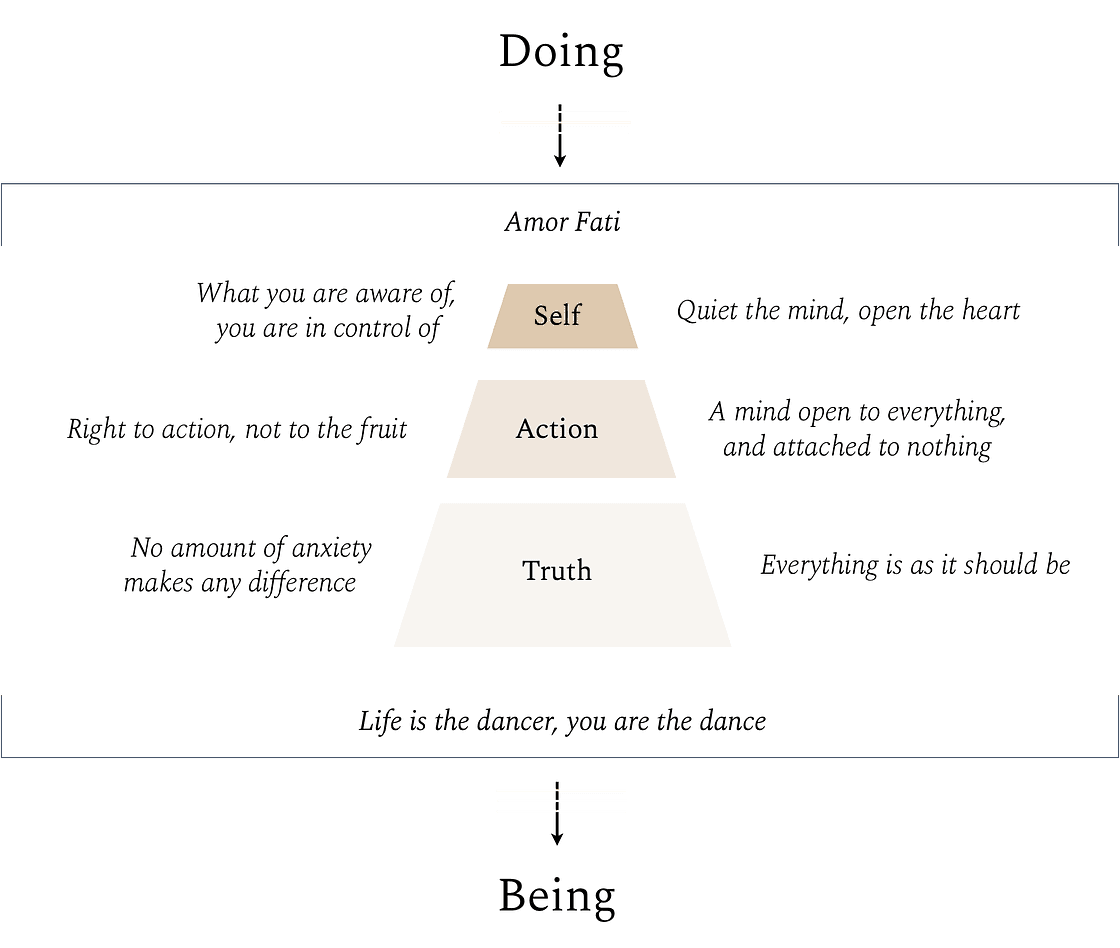
It’s worth noting that this structure wasn’t pre-made. I didn’t draw a pyramid and try to stuff quotes into it. The process was the opposite.
I started by writing out every phrase, teaching, and insight that has truly spoken to me over the years. My intention was to reduce that list to the absolute minimum: a quick-reference set of anchors for daily life. These eight are the ones that survived.
Only after I had this final list did I step back and see the relationships between them. I realized they naturally organized themselves into layers between the poles of active Doing and surrendered Being. The map emerged from the mantras, not the other way around.
Of course, many other teachings resonate with me. A few favorites that didn’t make the cut include:
“There are no justified resentments.” — 12-Step wisdom
“If you label me, you negate me.” — Søren Kierkegaard
“Tell the truth and love everybody.” — Neem Karoli Baba (Maharaji)
“How may I serve?” — popularized by Wayne Dyer
“Until you make the unconscious conscious, it will direct your life and you will call it fate.” — Carl Jung
But for now, this pyramid is the complete picture for me: the simplest possible map of the journey from strong intention to gentle release.
A Final Note
I want to return to something I said at the beginning.
This framework is mine. These are the mantras that stayed with me. If any of them resonate with you, wonderful. But the deeper invitation is to build your own.
Read widely. Listen to people who have lived deeply and learned through that living: the Stoics, the mystics, the poets, the sages. They’ve been pointing at the same truths for thousands of years, just using different words. Be open to what they have to say. Because wisdom has a way of finding you when you’re ready to recognize it.
And then wait.
Not everything you read will land. Some ideas will fade. Others will stay. The ones that stay, the ones you keep returning to, the ones that quietly reshape how you see: those are yours.
My only suggestion is this: don’t just collect quotes. Let them connect. See how they relate to each other. Build a framework, even a rough one. Isolated wisdom is easy to forget. Wisdom that’s woven together becomes something you can actually live by.
And if, somewhere along the way, one of these truths moves from your mind into your heart, then it’s no longer just a phrase.
It’s yours now.
With love, always.