Root to Crown: Let's Return
Twenty-one days later, and back at the beginning

Twenty-one days ago, we began close to the ground.
We began with contact: the feet, the hands, the knees, the parts of the body being held by something beneath them. We began with the breath as it was, the body as it was, and the mind we happened to have that day.
Now we have reached the end of the journey.
Or at least, we have reached the end of these twenty-one days.
Practice complicates the idea of an ending. We begin, lose the thread, and return. We place our attention, follow a thought somewhere else, notice what happened, and return. We feel steady for a while. Then life changes, the body changes, the mind changes, and we return again.
So perhaps arriving here does not mean that we have finished. Perhaps it means that we now understand the beginning a little differently.
The path we followed
The journey moved through seven phases, but those phases were never meant to be seven separate compartments. Each one prepared something for the next.
Foundations brought us into contact with support. We stayed close to the floor, felt the weight of the body, and practiced allowing the ground to carry some of what we had been holding ourselves.
Curiosity introduced movement without an immediate conclusion. We explored sensation, shape, and possibility before deciding what an experience meant.
Commitment gathered that openness into direction. We worked with repetition, strength, and the choices we make before the difficult moment arrives.
Challenge brought us to the height of the arc. The practice became warmer, stronger, and more complex. We met effort, resistance, and the impulse either to force or to leave.
Surrender asked us to stop adding quite so much. We began to distinguish giving up from letting go, and effort from the attempt to control every outcome.
Love turned our attention toward warmth, relationship, compassion, gratitude, and service. We practiced opening without losing ourselves.
Integration did not ask us to add one final achievement. It asked us to sit with all the pieces together and notice what remained.
The phases have names, but experience rarely arrives so neatly. We may need grounding in the middle of Challenge. We may meet resistance during Surrender. Love can require strength. Curiosity can return after we thought we had already decided.
The way I see it, the sequence gave us a structure, instead of a rule about the order in which a person must grow.
The eight threads
Looking back, we can also understand the journey through eight qualities that moved across all seven phases: grounding, strength, heat, complexity, balance, flexibility, stillness, and heart opening.
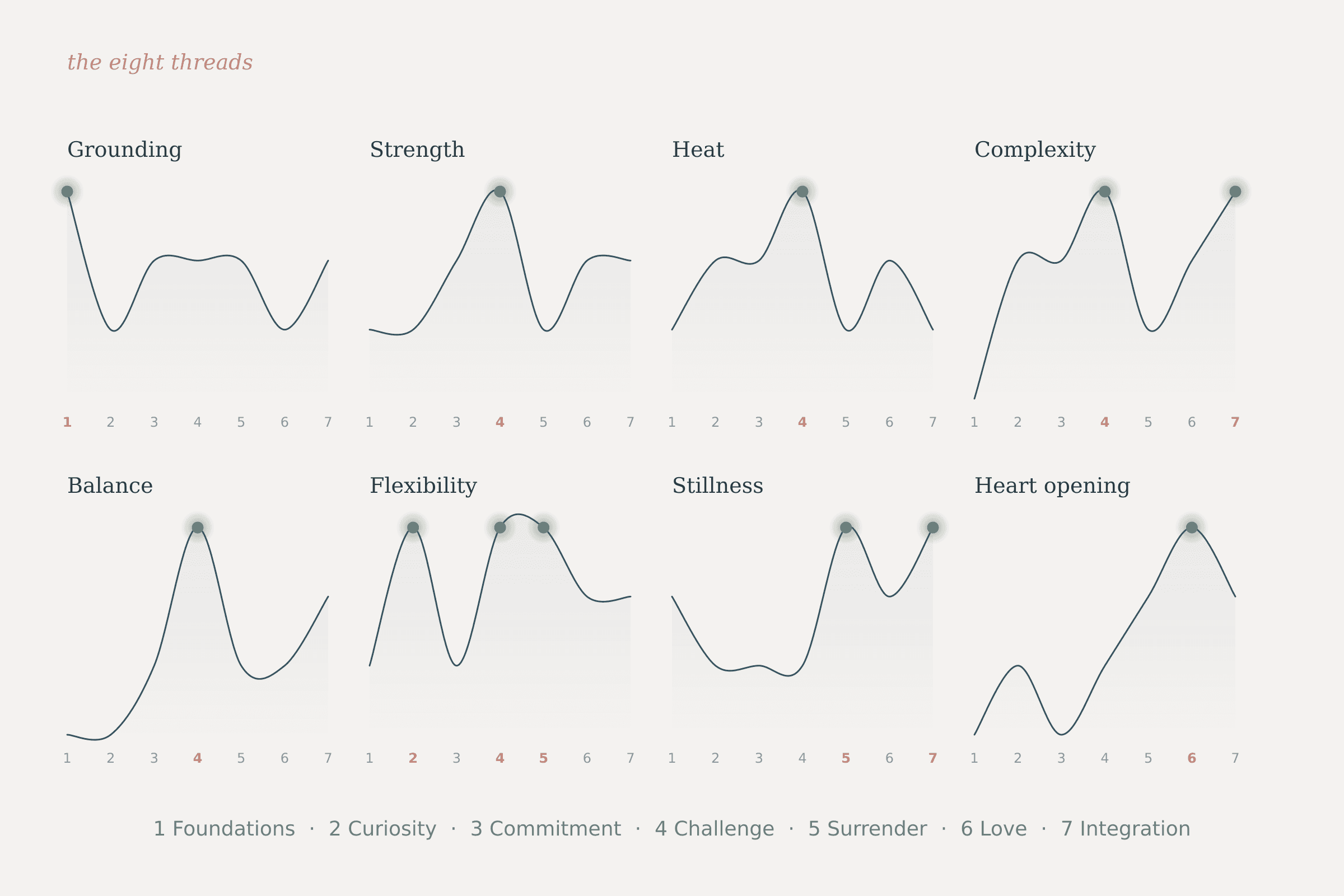
I did not design this chart as a scorecard, or a prediction of how each person should have experienced the practices. But rather it is a design map: a view of which qualities the sequence emphasized at different points in the journey.
We can see that some threads rise early, while others develop later. Some recede so another quality can come forward.
Grounding is strongest at the beginning, when our first task is to establish contact. But it never disappears. Without some relationship to the ground, balance becomes only the effort not to fall.
Strength rises toward Commitment and Challenge. Flexibility moves differently, sometimes increasing when strength is asked to soften and sometimes appearing as the ability to adapt rather than the ability to move farther into a posture.
Heat builds as the arc rises. Stillness deepens later, although stillness does not necessarily mean that nothing is happening. A quiet posture can contain intensity. An active sequence can sometimes produce a very quiet mind.
Complexity peaks when the practice asks us to coordinate more information, effort, and choice. Heart opening follows another rhythm. It does not emerge because complexity has been defeated, but because the practice begins to turn from managing the shape toward meeting what the shape reveals.
Also, I tried to organize and define these qualities not simple opposites, but counterweights. That is, each one changes the meaning of the others.
Strength without flexibility can become rigidity.
Flexibility without strength can become instability.
Heat without stillness can become agitation.
Stillness without vitality can become withdrawal.
Balance depends on grounding.
And heart opening without discernment is not necessarily love.
Finally, integration is the capacity to hold more than one quality at a time and respond to what the moment actually needs.
What movement was teaching
The movement practices gave us something concrete to meet.
A foot either felt the ground or it did not. A leg was working. The breath became strained. The body wanted to move farther, remain where it was, or come out.
That concreteness matters.
Many of our emotional and psychological patterns can feel abstract until they appear in the body. On the mat, force becomes physical. Avoidance becomes physical. Impatience becomes physical. So do steadiness, curiosity, commitment, release, and care.
This does not mean that every posture contains a hidden psychological message, or that tension in one area of the body always corresponds to one particular emotion. Human beings are more complicated than that.
It means that movement gives us a smaller place in which to observe how we relate to experience. Let me write out a couple questions that hopefully you can relate to:
What happens when something becomes difficult?
Do we immediately push harder?
Do we leave before we have gathered enough information?
Can we distinguish discomfort from harm?
Can we choose a version of the posture and give that version our full attention?
The body does not answer these questions in theory. It answers them in the choices we make while we are there.
What the breath was teaching
The breath accompanied every part of the journey, but it did not do the same work every day.
Sometimes it gave movement a rhythm.
Sometimes it helped us steady our arousal after effort.
Sometimes breathing itself became the practice.
Sometimes we stopped directing it and observed what happened when the breath was allowed to breathe itself.
Breathwork and meditation are related, but they are not interchangeable. Breathwork asks us to work intentionally with breathing. Meditation asks us to work intentionally with attention and experience.
The breath often became the bridge between movement and stillness.
After the body had been moving outward through space, the breath offered a simpler place to gather. We could feel it, influence it gently, and eventually stop managing it quite so much.
The traditional language of prana gives the breath an energetic meaning. Modern physiology gives us another lens through which to understand changes in arousal, heart rate, and autonomic activity. We do not need to collapse one language into the other to work respectfully with both.
At the most immediate level, we can notice something simple: changing the way we breathe can change the way a moment feels.
What sitting was teaching
On the third day of every phase, the body became quieter. While, most likely, the mind often did not.
I tried to really emphasize throughout our journey that a wandering mind was not evidence that the meditation had failed.
One of the most useful distinctions in this journey was between dharana and dhyana.
Dharana is the practice of placing attention. We may place it on the breath, a sound, a sensation, a mantra, an image, or a question.
Dhyana describes a more continuous meditative flow that may arise from that practice.
Remember:
We can choose to sit. We can choose the method. We can notice that attention has moved and place it again.
However, we cannot command the meditative state to arrive at a particular minute simply because we have decided that now would be convenient.
We can choose the practice. We cannot require the state.
The trainable moment is not the moment in which the mind becomes perfectly silent. It is the moment in which we recognize that we have been carried away and discover what happens next.
And when that happens, we have options. Sometimes we return to one point, or widen our attention. Sometimes we ground in sensation. Or sometimes we give the mind something to investigate.
There is no single meditation because attention can be trained in different ways, and because there are many kinds of minds, along with many states of the same mind.
What psychology adds
Eastern and Western psychological traditions often begin with different assumptions, use different language, and ask questions at different scales.
Western psychology may help us understand attention, regulation, cognitive habits, emotional responses, learning, avoidance, attachment, and behavior.
Eastern traditions may ask what the mind is, how identification creates suffering, what remains when thought is observed rather than obeyed, and what freedom ultimately means.
They should not be treated as interchangeable merely because some of their ideas sound similar. But they can illuminate different parts of the same lived experience.
A thought arises.
From a cognitive perspective, we may ask whether it is accurate, what triggered it, and how it influences behavior.
From a mindfulness perspective, we may notice it as an event occurring in awareness.
From a yogic or contemplative perspective, we may ask who or what is aware of it, and why we so quickly experience the thought as ourselves.
These are not identical questions. We do not have to choose only one.
One of the practical effects of meditation is that it can create a little more room between an event, the meaning we assign to it, and the action that follows.
That small amount of space does not remove emotion or make us indifferent. It gives us a greater chance of responding intentionally rather than being completely governed by the first interpretation that arrives.
What non-attachment means here
This space is also where meditation meets non-attachment.
Non-attachment does not mean that we stop caring.
We still choose. We still prepare. We still work, hope, love, protect, and try.
The practice is learning to participate fully without making our inner stability entirely dependent on the outcome.
We act, but we cannot control every consequence of the action.
We love, but we cannot guarantee how love will be received.
We prepare, but we cannot remove uncertainty.
We offer our effort. We loosen our demand that reality unfold according to the exact shape we imagined.
This is not a single realization we acquire and keep forever. It is something we remember, lose, and return to.
What love and service have to do with it
For me, the arc does not end with private insight.
A practice that makes us calmer but less available to other people would feel incomplete. So would a practice that increases our self-knowledge without changing how we treat the lives around us.
The conclusion I keep returning to is simple: we are here to love and to serve one another.
I do not mean that as decoration.
I mean that the steadiness we develop becomes useful when someone else needs steadiness.
The curiosity we practice becomes useful when we are tempted to assume that we already understand another person.
Commitment becomes useful when care requires consistency rather than a feeling.
Surrender becomes useful when love asks us to stop controlling.
Compassion becomes useful when another person is struggling—and when the person struggling is us.
The practice comes back into relationship.
It comes back into how we speak, listen, repair, choose, and help.
[Optional pull quote: “The real practice is not whether we can create a beautiful hour on the mat. It is whether that hour changes the way we inhabit the next ordinary one.”]
What may remain
Twenty-one days may not have transformed us into entirely different people.
That was never the requirement.
Perhaps we know the body a little better.
Perhaps we notice sooner when effort becomes force.
Perhaps we understand which forms of meditation feel stabilizing, which feel spacious, and which require a different time or a different state of mind.
Perhaps we know one breath practice that helps us settle.
Perhaps we can remain with discomfort for one breath longer without immediately reacting.
Perhaps we have learned that the two sides of the body do not have to match.
Perhaps we know that today does not have to match yesterday.
Perhaps we understand that beginning again does not mean that the earlier practice was lost.
Small changes in how we meet experience are still changes.
A few questions to carry forward
We do not need to answer these immediately. They are simply places to return.
Which phase felt most familiar?
Which phase created the most resistance?
What helped the body feel supported?
When did effort become useful, and when did it become force?
Which meditation gave attention the most natural job?
What changed when the breath became slower or less managed?
What are we able to notice now that we may not have noticed at the beginning?
Where in ordinary life do we most need grounding, curiosity, commitment, surrender, or compassion?
What would it mean to return without treating ourselves as though we had failed?
Back at the beginning
The journey was called Root to Crown, and the name gives it an upward direction.
But the lived path was never entirely upward.
We rose, returned to the ground, rose again, became tired, rested, opened, closed, remembered, and forgot.
Even the breath did not move in one direction. We inhaled, reached the height of the arc, exhaled, emptied, and began again.
The point was not to leave the root behind once we reached the crown.
The point was to carry grounding into balance, flexibility into strength, stillness into heat, and the heart into everything that came after.
So we return.
To the body before the story about the body.
To the breath before we try to change it.
To the thought before it becomes an unquestioned truth.
To effort without force.
To care without complete control.
To the people around us.
To the beginning.
Not because nothing changed.
Because we have changed enough to meet the beginning differently.
Twenty-one days later, we are back where we started.
Let’s return.
[Final visual suggestion: End with a simplified version of the continuous ribbon curving back toward the small golden seed from Foundations—not closing into a perfect circle, but arriving near the beginning with space left for another cycle. No text inside the visual.]
With love, always.