Phase 1: Foundations
The phase that asks nothing of you

Grounding is often described as the thing we establish before the real work begins. I have come to think of it differently.
It does matter before we explore, commit, or meet something difficult. But it also matters when there is nowhere to climb and nothing we need to accomplish next. Most of life is not the peak. Most of life is the ordinary space between peaks, and I want to know how to be steady there, too.
So, that is where this journey begins.
The phases that follow will ask us to move in different ways. Curiosity asks us to explore. Commitment asks us to choose and continue. Challenge asks us to meet an edge. Surrender asks us to release. Love asks us to open. Integration asks us to gather what the practice has changed.
Foundations, the very first phase of this journey, is different. It begins with a simple cue:
"You are here. That is the whole instruction."
What grounding means
For me, grounding begins with contact, breath and intention.
Contact is the direct physical information beneath us: the feet pressing into the mat, the weight of the seat, the hands and knees meeting the floor. Grounding is not an abstract image when the body can feel exactly where it is supported.
Breath gives the practice its pace. I think of grounding as the breath slowing down, but also as speaking slowly and thinking slowly. It is the ability to let something pass through without requiring an immediate response. Simply giving the moment enough room to move before deciding how to act on it.
Intention is one clear quality we choose for the practice: steady, attentive, patient. Grounding is usually described as something the body does, and it is that. And it is also something attention does through intention.
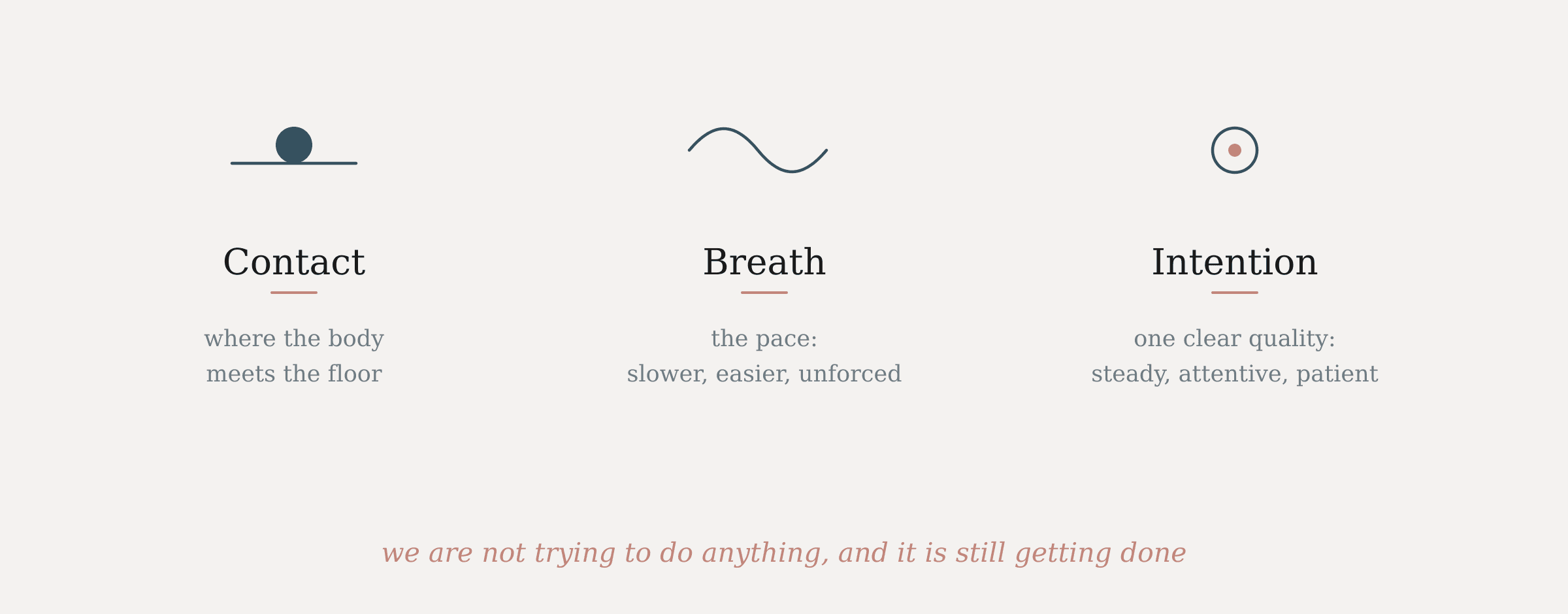
Together, these qualities make the body active without making the practice forced. Remember, in yoga in general, and especially in this phase of this journey, we are doing the practice without trying to force the practice. Or, in the shortest version: we are not trying to do anything and we are still doing it.
Muladhara: the root chakra
Foundations is viewed through Muladhara, the root chakra. The name combines mula, root, with adhara, base or support. In traditional chakra imagery, Muladhara is placed at the base of the body and associated with the earth element, the seed syllable LAM, and a four-petaled lotus. Modern yoga often identifies it with the color red and interprets it through grounding, stability, belonging, and material support.
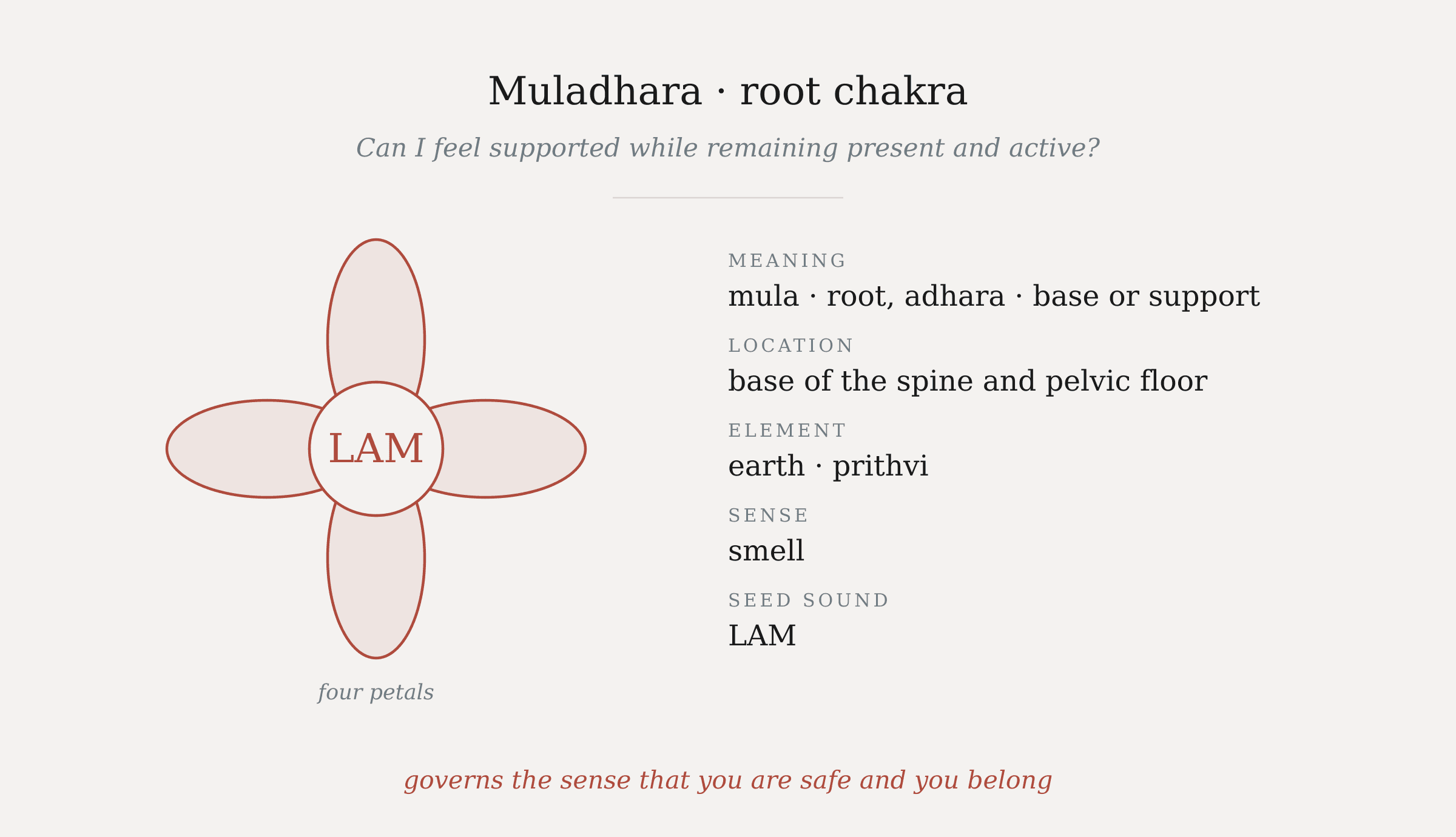
According to this chakra system, the root chakra governs the most basic thing there is: the sense that you have a place and you belong. When it is steady, you can rest. You are not braced for something. You can be somewhere without needing to be somewhere else next.
And when it is unsettled, it usually shows up as restlessness. Planning things that do not need planning yet. Often some tension in the legs, the feet, the low back. And when the root is steady, we can be somewhere without needing to be somewhere else next.
I like to think of an unsettled root as energy leaking into vigilance, instability, or constant searching for the next secure foothold. That image is a metaphor, of course. When the root is steady, the energy stays with you. So the goal becomes to build steadiness.
I use the chakra system here only as a lens, a perspective. I am not using it as anatomy, and I am not treating an unsettled feeling as a diagnosis. In my opinion, it is just another way to organize attention around the qualities we are practicing.
Three days towards one foundation
Every phase in this journey has three days: a slower practice that receives and studies the theme in the body, an energetic practice that works with it actively, and a longer meditation that takes it inward.
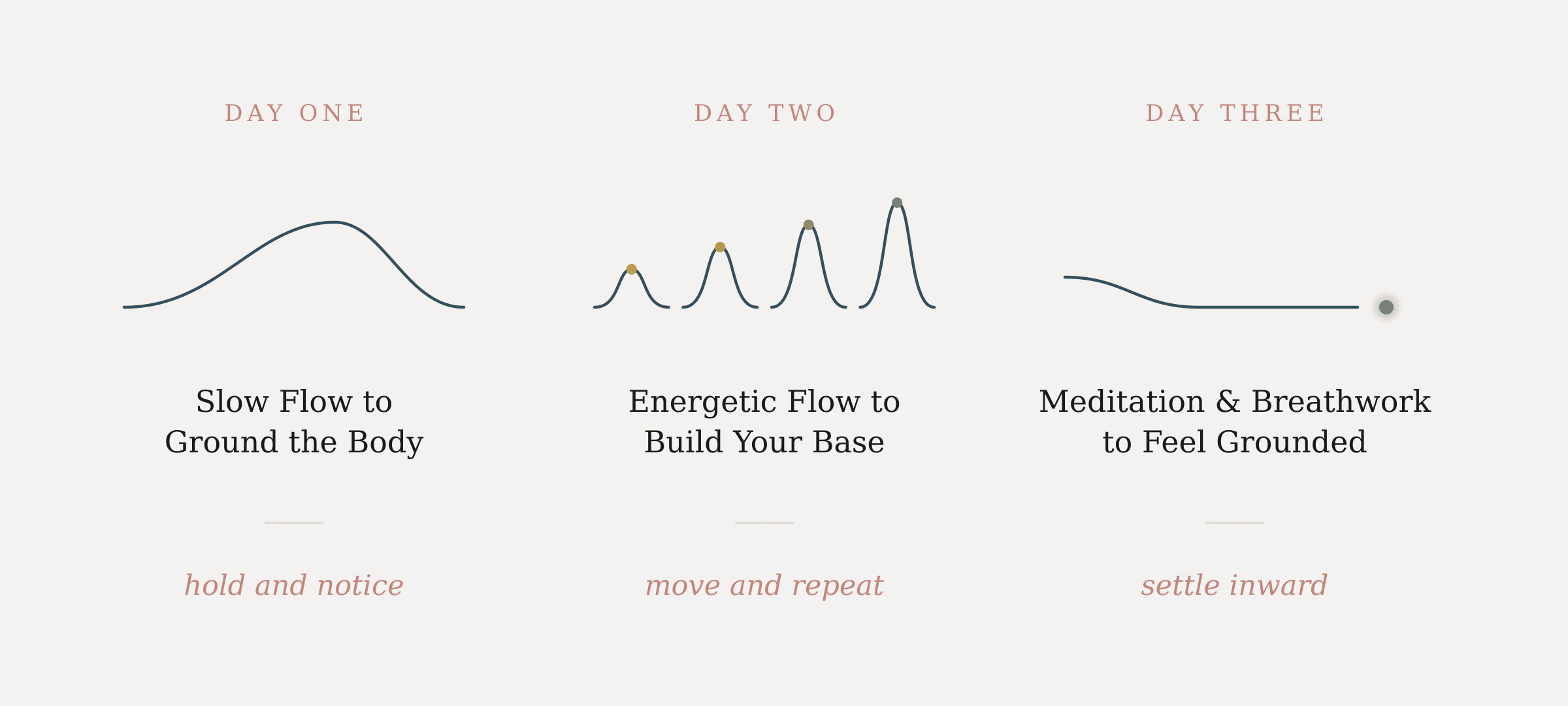
The first two days belong to the same physical family. Day One builds toward Malasana, the deep squat, supported as generously as needed with a blanket beneath the heels or a block beneath the seat. Day Two turns the same rooted leg pattern into active strength through Chair or Goddess, held after a progressive sequence with both feet planted.
Neither practice is organized around one-legged balance. Balance comes later in the journey. Foundations is about the broad base beneath it: contact, intention, mobility through the hips and ankles, and strength that rises from the ground.
The energetic day also introduces a structure I want to carry through the phases. The first round teaches the route. The second makes it familiar. The third adds complexity. The fourth brings the fullest expression. A final round, when it fits, becomes more breath-led and receives less explanation. Repetition is how the body learns.
The breath
There is also a physiological reason the breath belongs at the center of Foundations.
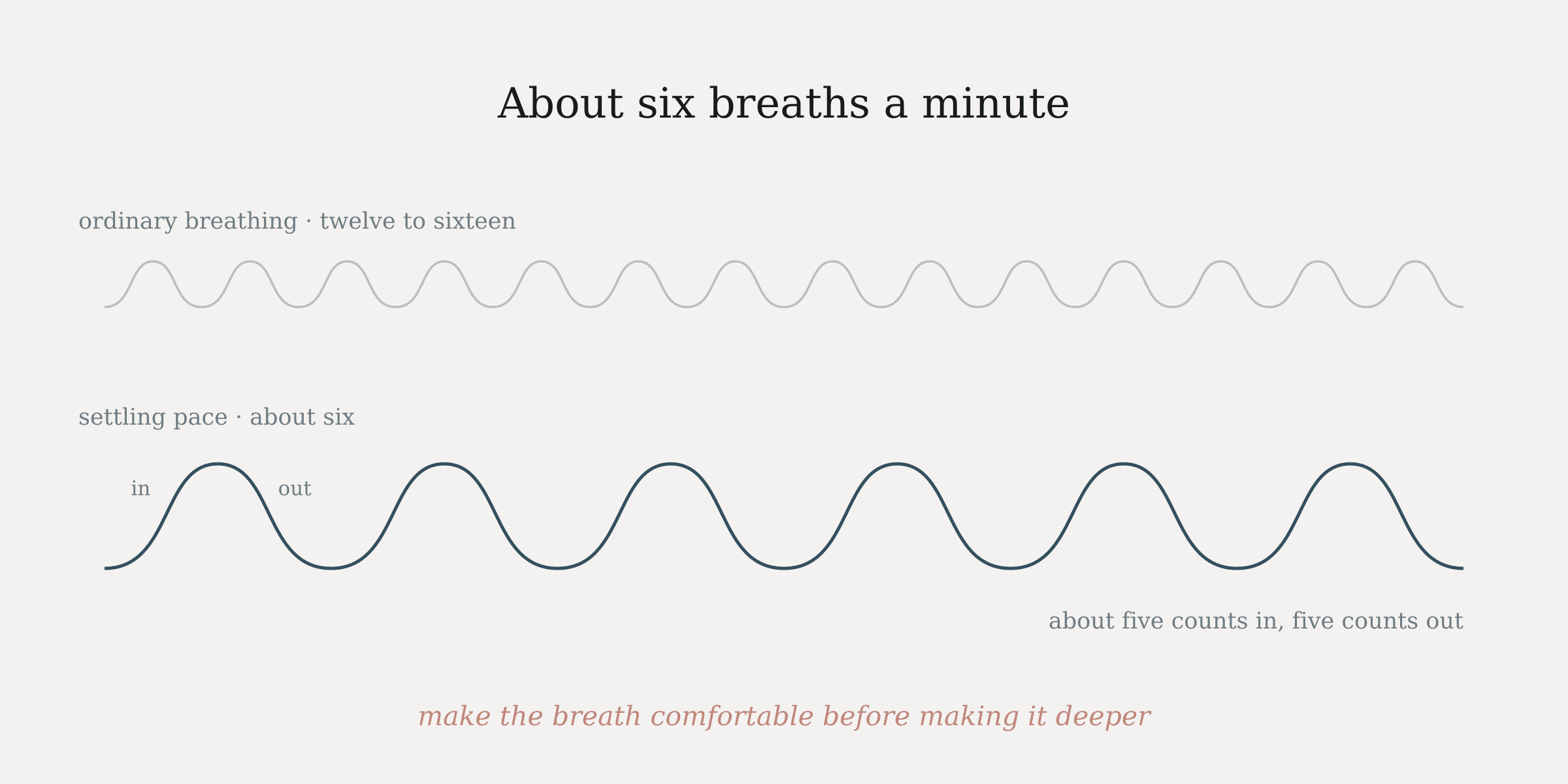
Slow, comfortable, regular breathing changes the rhythm of the cardiovascular and autonomic systems. The heart usually speeds up slightly during inhalation and slows during exhalation, a normal pattern called respiratory sinus arrhythmia. Breathing in the range of roughly five to seven breaths per minute often makes this rhythm more pronounced and can strengthen the interaction between breathing, heart rate, blood pressure, and the baroreflex. The exact pace is individual, so the point is not to force everyone into one count.
The vagus nerve is one of the major pathways connecting the brainstem with the heart, lungs, and digestive organs. Breath does not travel down the vagus nerve like a message on a single wire, and it does not flip the parasympathetic system on like a switch. Breathing changes pressure in the chest, lung stretch, carbon dioxide, heart rhythm, and sensory information reaching the brainstem at the same time. The body responds to the pattern as a whole.
That is why I prefer a simple cue: let the breath become slower and easier. Around five counts in and five counts out may feel steady. A slightly shorter inhale and longer exhale may feel better for someone else. The useful breath is the one that remains comfortable.

During exhalation, vagal influence on the heart generally increases and the heart rate slows slightly. Lengthening a comfortable exhale gives that naturally slower part of the breathing cycle a little more time, which may make the breath feel more settling.
I do not think of this as forcing calm. I think of it as offering the body a clear rhythm it can respond to.
Practicing the element
The element of this phase is earth, and there is something direct about practicing it outside. Grass, firm dirt, or damp sand can make the idea literal. The feet and hands receive information from an actual surface rather than an imagined one.
The point is not that nature makes a practice more authentic. The point is simply contact. Wherever you practice, notice the points beneath you. Let the weight go down. Press evenly. Feel what becomes steadier.
Beginning
The invitation for these three days is clear: notice your ground, let the breath set the pace, and begin with one intention.
The first practice is:
Foundations · Slow Flow to Ground the Body
Start whenever you are ready, wherever you are. And I will meet you there.
With love, always.